
Why Not Repair Ourselves First?
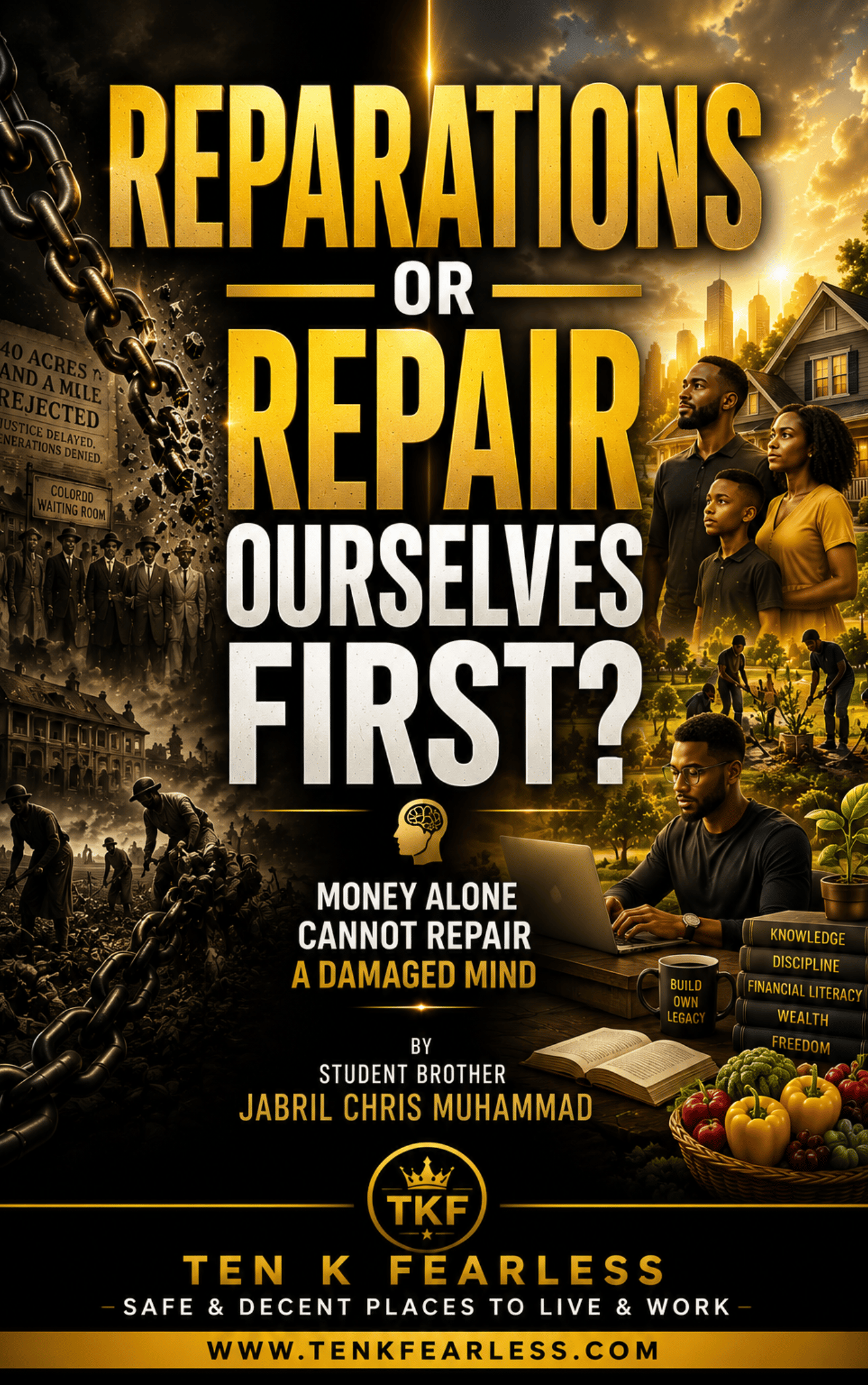
REPARATIONS OR REPAIR OURSELVES FIRST?
Money Alone Cannot Repair a Damaged Mind
For generations, the debate over reparations has echoed through courtrooms, classrooms, political campaigns, churches, and communities across America. Some demand compensation for historical injustice. Others question whether money alone can heal centuries of damage.
But what if we are asking the wrong question?
What if the greatest wealth we have lost is not money—but knowledge of self, discipline, unity, health, character, purpose, and vision?
In REPARATIONS OR REPAIR OURSELVES FIRST?, Student Brother Jabril Chris Muhammad challenges readers to confront one of the most important questions of our time:
Can a people be repaired externally before they are repaired internally?
This powerful and thought-provoking book explores the relationship between justice, self-improvement, economic development, family restoration, spiritual awakening, and community transformation. Rather than waiting for politicians, governments, institutions, or outside forces to solve our problems, this book presents a blueprint for rebuilding ourselves from the inside out.
Inside these pages you will discover:
- Why money alone cannot repair a damaged mind
- The hidden cost of dependency and victimhood
- How knowledge of self becomes the foundation of freedom
- Why discipline is more valuable than a government check
- The connection between economic power and personal responsibility
- How broken families weaken communities and how strong families rebuild nations
- Practical principles for developing wealth, ownership, and self-sufficiency
- The importance of health, education, and moral character in true liberation
- How communities can create safe and decent places to live and work
- Why self-repair and collective advancement must happen together
Drawing upon history, personal responsibility, economic principles, spiritual insight, and community-building strategies, this book refuses to offer excuses while simultaneously refusing to ignore legitimate historical grievances.
Instead, it presents a bold challenge:
If reparations came tomorrow, would we be prepared to multiply them—or merely consume them?
This is not a book about blame. It is a book about power.
It is a call to rebuild the mind, strengthen the family, create wealth, restore purpose, and develop the character necessary to sustain freedom for generations to come.
Because a repaired people can preserve what others cannot.
A repaired people can build what others cannot. A repaired people can create a future that no one can take away.
The question is no longer whether reparations should happen.
The question is this: Are we repairing ourselves right now?
A bold manifesto for self-improvement, economic empowerment, community development, and generational transformation.